
Sections
Get R.E.D.E.E. with RHBA
(Real Emergency & Disaster Expertise & Equipment)
R.E.D.E.E. is a series of online sessions with expert guidance on on emergency and resiliency and a living guide of resources and best practices for small biz to get ready and stay ready. This page has info, resources, and recordings and takeaways from each online session. You can also download your own Small Business Preparedness Guide filled with worksheets and outlines to have on hand.
01.Know Your Risk
-
Learn more about Red Hook’s unique risk profile.
-
See tips and tricks from our partners at The City Sponge/Floodline. Or check out the full session from our R.E.D.E.E. Fest Series.
-
Learn fire safety and preparedness tips relevant to Red Hook’s unique types of biz.
-
daily, weekly, monthly, and seasonal preparedness tips for flood and fire
-
Explore resources pertaining to fire, flood, and other risk.
02.Know Your Coverage
-
Find out what many policies miss and what to ask your broker.
-
Learn about how to get prepared for our upcoming event.
03.Know Your Plan
-
Learn about biz continuity and how to plan for the unexpected
-
Learn more about the process of building business continuity or see the full session and key learnings
-
Download our interactive guide and give a copy to the person you trust to act on your behalf in an emergency. Great for single person operations.
-
Find more tips, tricks, and best practices.
01.Know Your Risk
FLOOD
Red Hook is no stranger to water. Storm surge, sewer backup, high tide, and cloud burst all should be considered in your risk assessment.
FIRE
Your building or business type may increase your risk, but a neighboring fire can impact you, too. Flammable materials, gas, space heaters, and aging electrical are risks.
UTILITIES DISRUPTION
Extended outages disrupt refrigeration, POS systems, production equipment, security, and communication. Low voltage, brief outages, and surges can damage equipment.
ACCESS DISRUPTION
Closed, blocked, or damaged roads or public transportation can slow or stop the ability for employees, customers, and/or vendors to get to you. Dept. of buildings could deny access to your building for other reasons. Supply chain disruption is also included here.
ILLNESS/ INJURY
Personal illness, injury, or family emergency can disrupt your business operations if you don’t have a plan for continuity.
EXTREME WEATHER (HEAT / HEAVY SNOW)
Weather that used to be normal now causes significant disruption worth preparing for.
Red Hook businesses face a compounding set of hazards. Identifying the most likely / frequently to affect your operation while thinking through the impacts each would cause will help guide and prioritize your planning.
CYBER ISSUES
Security breaches, outages, or lost data for any reason can cause costly disruptions.
PUBLIC HEALTH EMERGENCY
Lessons from COVID can help minimize impacts from future public health emergencies.
FloodTOP FLOOD TIPS FOR SMALL BIZ BROUGHT TO YOU BY THE CITY SPONGE
Get barriers for stopping or diverting water
Consider water-activated barriers or flood gates
Focus on low openings and front/back doors
Have extra supplies to direct water to pumps
Address drain and sewer backup
Install a backflow valve where needed with landlord approval
In unused drains, install plugs or ‘balloons’
Elevate critical inventory and equipment
Store inventory, appliances, and electronics at least 2 ft above floor level
Always elevate EV batteries / eBikes as they can explode when turned on after getting wet
Elevate toxic chemicals to avoid combining with floodwater
Create a simple ‘3-hour storm plan’ with critical action items like :
Where you will move expensive inventory
Deploy barriers to seal areas or direct water to pumps
Unplug and elevate electronics
Ensure your team knows what to do
Identify if you can send or divert water to green areas rather than street to avoid inundating neighbors
Take documentation
Before emergencies, make sure to have your inventory up to date and take pictures and videos of your space, especially doors, drains, and basements
Capture photo and video documentation of flood effects
Track cleanup costs, damage, and economic injury (i.e. lost business days)
Submit complaints / keep the city informed
Report damage from sewer backup to NYC Comptroller
File for government funds through the recovery portal (opens after flood event)
Submit complaints to 311 to bring attention to the event, it helps prioritize the flooded area
R.E.D.E.E. Fest Session 1
Flooding Q&A with The City Sponge:From Risk to Solutions
Thanks to those that joined us for our first virtual session of our R.E.D.E.E Series: this series of workshops, Q&A’s, and clinics have been designed to help small biz stay in biz through preparedness and resilience.
On Monday evening, we gathered for a Flood Q&A with Nick Nyhan of The City Sponge and Floodline. You can check out the full session here and peruse through some key takeaways below.
THE BIG PICTURE - “A BUCKET IS NOT A STRATEGY” - THINK ABOUT FLOOD BEFORE, DURING AND AFTER.
Urban flooding, especially in Red Hook is misunderstood (both by those affected and especially by electeds/officials).
This misunderstanding costs businesses.
It is critical to have a strategy in place BEFORE flood strikes…. And as Nick put it…’a bucket is not a strategy!’
Urban flooding is widely misunderstood -- and that misunderstanding costs businesses. As Nick put it: a bucket is not a strategy. The conversation we need to have goes from plumbers to policy.
Look at the flood section of our workbook for more info.
Before a flood:
Know your space. Walk it. Learn what happens in what order when it rains hard.
Check your sump pump annually. The most common failures are gunk buildup, a stuck float, or a stuck valve. Ask your landlord to maintain it yearly. Also check the pump's lift height to make sure it can actually move water out effectively.
Install stick sensors in pits and low areas to get early warning.
Keep barriers on hand for doors and rolling gates. Check out Garrison Flood Control for doors and rolling gates, and water-fillable door guards as another option.
Document your space now -- photos and video of doors, drains, and basements before anything happens. Keep your inventory up to date and photographed.
If you apply for any grants or loans -- especially flood-related -- copy and paste your Q&A responses as you go. Not all programs will send them back to you, and you'll want to reuse similar answers.
If a physical disaster is declared: if you have an open line of credit that is not maxed out, you may be required to take it at a higher interest rate before accessing other assistance. Know this ahead of time.
During a flood:
Do not shower or flush toilets during heavy rain. It stresses already-overwhelmed sewer lines and can make backup worse.
Think about where you are directing water -- avoid sending it somewhere that will hurt your neighbors. Take a community mindset.
Document everything in real time. Photos and video with timestamps.
After a flood:
When talking to your insurance company: do not describe what you think caused the flooding or where it came from. You don't know. There was water. That's all you know. The type of water determines coverage, and guessing wrong can hurt your claim.
Report damage from sewer backup to the NYC Comptroller. Report damage from sewer backup to NYC Comptroller
File for government funds through the recovery portal once it opens.
Submit a 311 complaint -- it helps prioritize the flooded area and creates a paper trail.
THE DATA GAP: FLOODING MADE INVISIBLE
Flooding is invisible to policymakers because the maps are not accurate. Official flood risk maps are incomplete and don't reflect what has actually happened in your specific space. Real risk is based on what has happened in your location over the last 6 to 15 years -- not what a map says. Talk to prior tenants, ask neighboring businesses, and pay attention to what you observe during storms: where does the water come from, where does it go, in what order do things happen?
Outside water is just one type of flooding. Sewer backup, roof drainage, internal plumbing failures are all flooding types that occur in our area, and they're covered differently by insurance, if at all.
NEW MODES OF RESILIENCE
We discussed emerging modes of resilience we have seen in other communities including
Mitigation libraries (community owned mitigation tools available for use)
Group shared insurance policies based on weather events may be an emerging option for small businesses -- including possibly for Red Hook specifically. We're looking into this and will follow up.
Advocacy efforts to push for flood disclosure requirements for commercial tenants -- we're adding this to our policy and advocacy agenda
Pooled/parametric insurance as an option for Red Hook businesses -- not just for flooding
Session 1: Flooding Q&A FireTOP FIRE TIPS FOR SMALL BIZ BROUGHT TO YOU BY NY Fire Consultants
Safe storage
Store stains, finishes, and solvents in proper flammable storage cabinets
Consider creating a policy banning storage/charging of scooters/e-bikes inside
Never leave rags in closets, piles, or open containers in shops as they can generate heat and spontaneously combust
Store used rags in a metal container with a tight-fitting metal lid labeled ‘Flammable Rags’
Store flammable materials in a yellow, metal, vented fire-rated cabinet.
Storage of more than 20 gallons of flammable liquid requires a special permit from FDNY
Exit, escapes, and access
Keep all exits and exit routes completely clear at all times: no garbage cans, boxes, deliveries, baby carriages, bikes, scooters, or storage in front of exit doors or in exit corridors
Make sure exit signs and emergency lights are working.
For buildings with window gates/bars: use approved window gates that open quickly from the inside without a key and never install non‑removable bars on required escape windows
Extinguishers
Check your extinguishers: Confirm they’re visible, accessible, and the gauge is in the green
Extinguishers must be maintained and tested every six years by a qualified professional
Have a plan and get trained
Designate a fire safety point person or small team
Provide professional training where possible
Staff should be trained to iIdentify and report blocked exits, bad storage, battery hazards, dust buildup and know where exits are and what the evacuation plan is.
Stay Ready 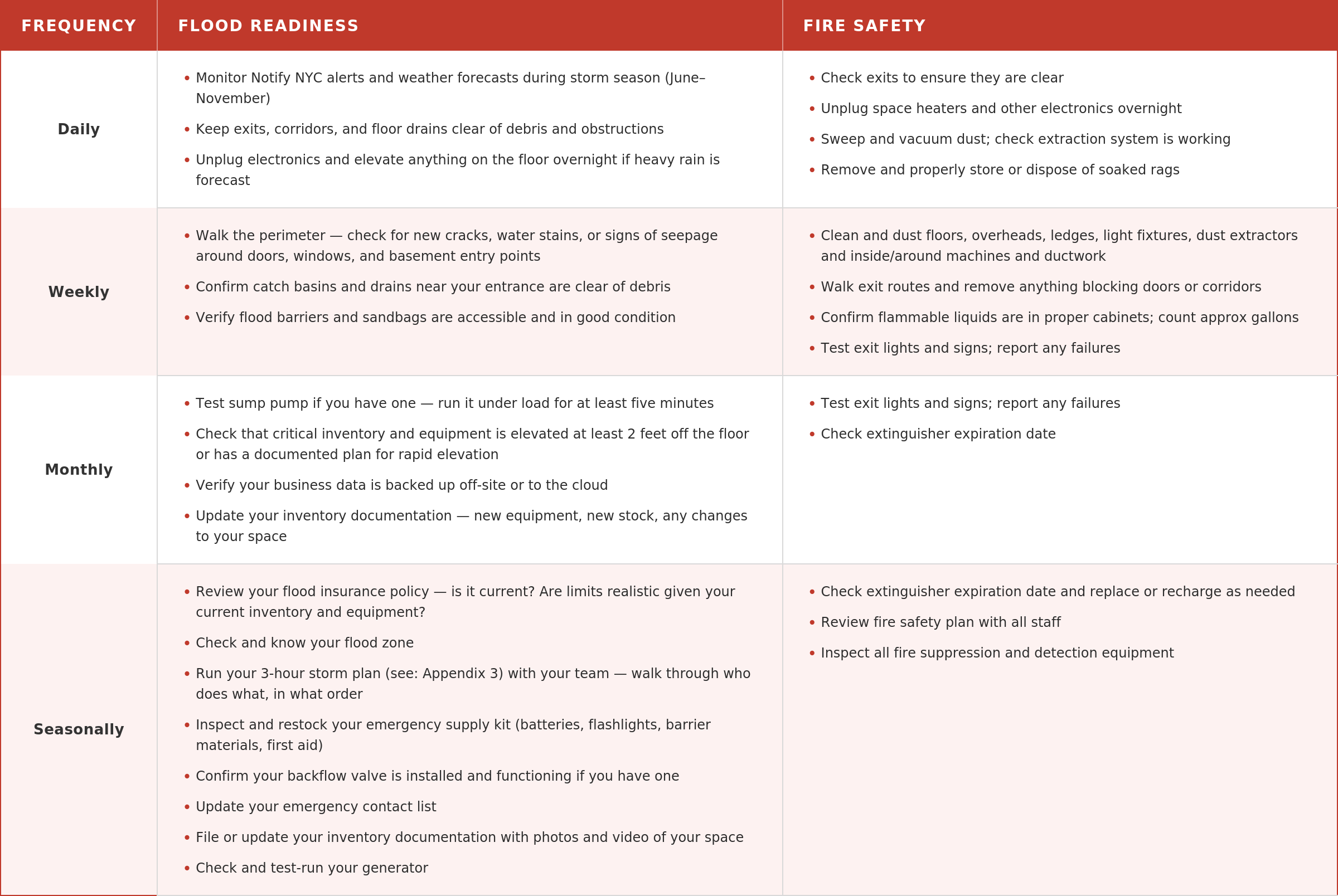
Flood + Fire ResourcesFLOOD
Know Your Zone — NYCEM's Hurricane Evacuation Zone Finder lets you look up your address to find out if you're in one of the city's six evacuation zones, ranked by risk of storm surge flooding, with Zone 1 being the most vulnerable. Red Hook sits in Zone 1. Look this up now, before a storm watch is issued — and make sure your staff knows the zone too. (NYCEM)
CitySponge Newsletter
Plan for Hazards: Flooding — NYCEM's comprehensive flood preparedness guide covering the different types of flooding that affect NYC, what to do before, during, and after a flood event, and how to clean up and prevent mold safely after floodwater enters your space. Includes the specific difference between a flood watch and a flood warning — worth knowing before storm season. (NYCEM)readyrating
Flood Safety — the American Red Cross's flood preparedness hub covering what to do before, during, and after a flood, including a downloadable flood safety checklist available in multiple languages. The "Turn Around, Don't Drown" guidance is particularly relevant for businesses deciding whether to send staff home during an active event. (American Red Cross)readyrating
Disaster and Flood Recovery — the New York State Department of Financial Services' guide to navigating insurance claims after a flood, including how to document losses, what standard policies typically exclude, how to work with public adjusters, and how to protect your credit during recovery. Essential reading before you file a claim — or better yet, before the storm hits. Call the DFS Disaster Hotline at (800) 339-1759 if you hit a wall with your insurer. (NYS Department of Financial Services)Resilient NY
Plan for Hazards: Fire — NYCEM's fire preparedness guide covering prevention, what to do if a fire breaks out in your space, and how to assess and repair damage after a fire. Includes specific guidance for high-rise and industrial buildings — relevant for Red Hook's mix of multi-story commercial and manufacturing spaces. (NYCEM)Resilient NY
Fire Preparedness Measures for Every Business — a practical guide from the U.S. Chamber of Commerce Foundation covering the most common causes of workplace fires by business type — including restaurants, manufacturing facilities, and offices — along with prevention measures and the three things every business needs: a no-overcrowding policy, a practiced evacuation route, and regular drills. (U.S. Chamber of Commerce Foundation)Resilient NY
File a Claim with the NYC Comptroller — if your business suffered damage from sewer backup or flooding linked to city infrastructure failure, you may be able to file a claim against the City of New York. File as soon as possible — there are strict deadlines. (NYC Comptroller)
Report Damage Portal — NYC Housing Recovery Operations' official damage reporting form for homeowners, tenants, and business owners impacted by a disaster. Your report helps the City provide accurate data to State and Federal agencies and may connect you to disaster recovery assistance and benefits you're eligible for. Call (212) 615-8329 if you prefer to report by phone. (NYC HRO / NYCEM
Red Hook WaterStories — a digital museum and resiliency resource from PortSide NewYork covering Red Hook's flood history, Sandy recovery, and preparedness planning, including flood maps, resiliency plans, and firsthand accounts from the neighborhood. The resiliency section includes flood prep information for residents and businesses developed directly from Sandy recovery work. Essential local context. (PortSide NewYork)
Storm Prep Info — SBIDC/Dewberry Training Session — materials from a storm preparedness training session held for Red Hook small businesses by the Southwest Brooklyn Industrial Development Corporation and Dewberry Consultants, covering temporary flood barrier solutions for renters and business tenants, including commercial products for doors, windows, and cellar hatches, and real examples of how Red Hook businesses protected their storefronts before Sandy. Archived on Red Hook WaterStories as part of the neighborhood's post-Sandy resiliency documentation. Read alongside theSBIDC Storm Preparedness Plan PDF — these two resources go together. (SBIDC / PortSide NewYork)
FIRE
Sign up for the NY Fire Consultants Newsletterto stay informed on fire safety best practices and see their handouts in Appendix 5
NYC Fire Code — the 2022 NYC Fire Code establishes legal fire safety requirements for all businesses and buildings in New York City, covering fire prevention, emergency preparedness, hazardous and combustible materials storage, and the design and maintenance of building safety systems. The FDNY also publishes a plain-language Fire Code Guide as a free PDF on the same page — worth downloading before your next inspection. (FDNY)First Onsite
FDNY Business Portal — FDNY's online portal for all compliance filings, including requesting or cancelling inspections, viewing permits and violation information, filing certificates of correction, and obtaining certificates of fitness. All services must now be filed online — no walk-ins or email submissions. (FDNY)Rebuild by Design
Fire Safety and Evacuation Plans — required for many commercial buildings, fire safety and evacuation plans must be submitted to FDNY for review, kept on-site, reviewed annually, and updated whenever the building's use or layout changes. If you're not sure whether your building requires one, call 311 and ask to be transferred to the FDNY Customer Service Center. (NYC Business / FDNY)
STAY INFORMED
NOTIFY NYC + CORPNET
Notify NYC is the City’s official emergency notification system. Receive free customizable alerts in 13 different languages for emergencies impacting your neighborhood including hurricanes, local mass transit disruptions, traffic delays, and more.You can sign up for citywide SMS text alerts by texting NOTIFYNYC to 692-692.
CorpNet is a free email notification service that provides business partners with current, accurate information about planned events and emergencies to enhance awareness and aid decision making. The information is generated by NYC Emergency Management Watch Command, which operates 24 hours a day, seven days a week.
FLOODCHAT
FloodChat is a free new chatbot to help NYC renters with flooding. FloodChat was built with support from Rebuild By Design and the Rainproof NYC program.
RED HOOK WHATSAPP CHANNEL FOR GENERATOR SUPPORT
Join the neighborhood WhatsApp group generator channel to help others or get help maintaining or troubleshooting a generator
NY FIRE CONSULTANTS EMAILS
Sign up for the NY Fire Consultants Newsletterto stay informed on fire safety best practices.
RED HOOK MUTUAL AID
Red Hook Mutual Aid is an independent corps of local volunteers: "who live in Red Hook and are working to make sure supplies, resources, and information are as inclusive, comprehensive, and accessible as possible to everyone in the neighborhood."
They provide phone support through a call-back system in five languages (English, Spanish, Arabic, Mandarin, and Russian).
646-484-9677
@redhookbklnmutualaid
CON ED
Report an issue to ConEd to receive updates automatically. Report an Outage or Service Issue | Con Edison
02.Know Your Coverage
Most small business owners don't find out their insurance wasn't enough until after something goes wrong. This section is designed to help you understand what you actually have, spot gaps before they become problems, and know what questions to ask your broker.
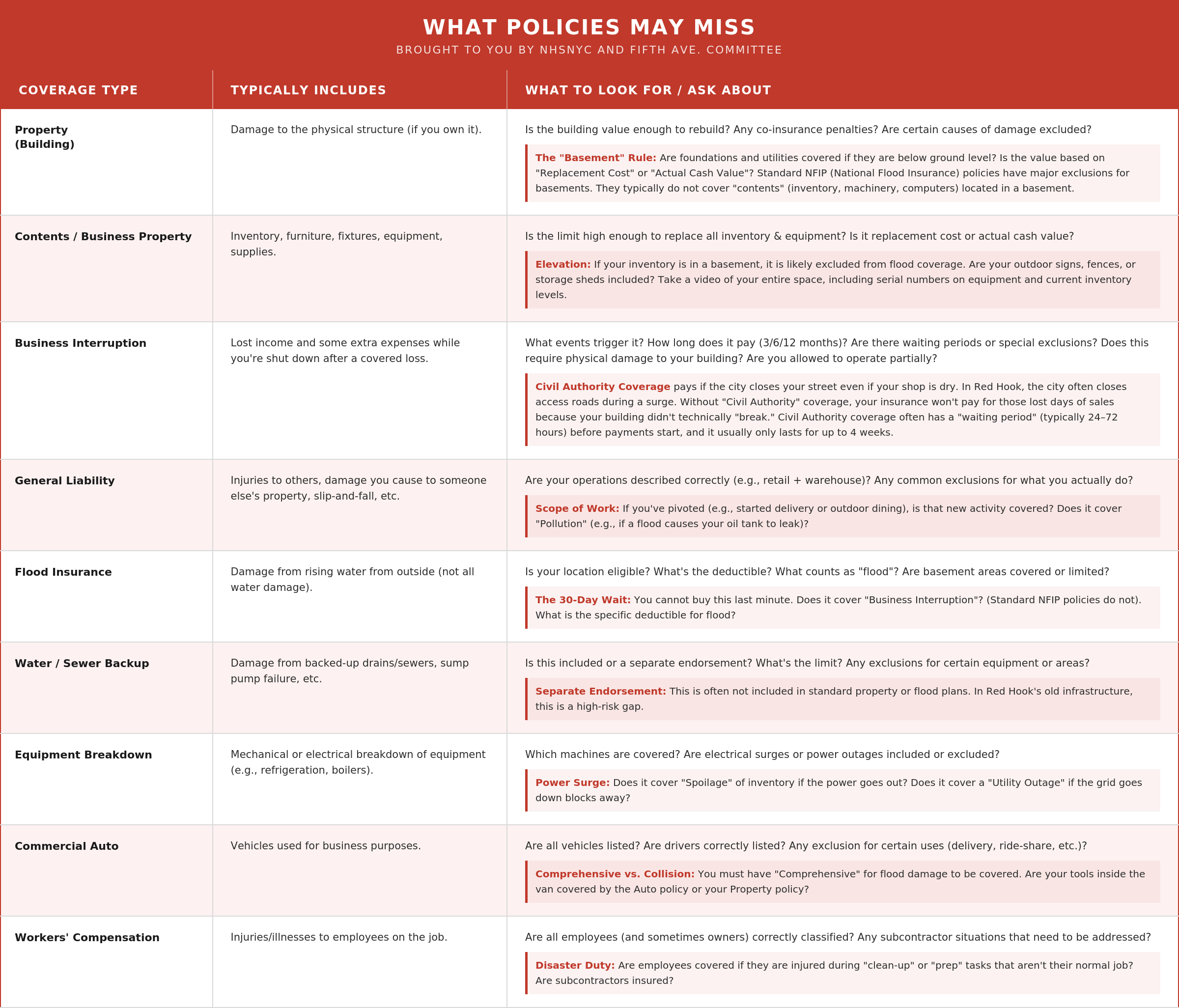
WHAT TO ASK YOUR BROKER/AGENT
BROUGHT TO YOU BY NEIGHBORS HELPING NEIGHBORS and NHSNYC
What exactly is covered if there is a fire in my space?
Does it cover building, contents, and business interruption (lost income)?
Are there any common exclusions (e.g., electrical issues, arson, contractors’ work)?
What isn’t covered that might surprise me?”
Ask them to list 3–5 common exclusions small businesses misunderstand.
If there’s flooding or water damage, what is and isn’t covered?”
Is flood (rising water from outside) covered at all?
Is sewer backup or rain coming in from a damaged roof treated differently?
What is my deductible in real dollars for a typical claim?”
Ask for a specific scenario:
“If I have $30,000 of damage, how much would I actually get after the deductible?”
Is my current coverage limit realistic for my business?”
Does the limit cover:
All your inventory
Fixtures and equipment
Cost to rebuild or re‑fit your space
Do I have business interruption coverage? What triggers it?”
What events qualify (fire, flood, power outage, access to street blocked, etc.)?
How long does it pay out (e.g., 3 months, 6 months, 12 months)?
How are special items covered?”
Refrigerated goods, high‑value equipment, art, tools, or custom build‑outs.
Ask if anything needs to be scheduled or separately listed.
How will my premium change if I increase/decrease certain coverages?”
Get 2–3 trade‑off examples (e.g., higher deductible vs. lower premium).
What discounts or credits can I get for risk‑reduction steps?”
Sprinklers, alarms, flood barriers, inventory tracking, etc.
If I have a loss, what are the first 3 things I should do for the claim?”
Ask them to spell out the step‑by‑step process.
"Do I have a 'Remote Operations' plan? Can my admin/billing/ordering be done from home if the physical shop is inaccessible?"
In a disaster, the biggest hurdle is often that staff cannot get to work because the B61/B57 isn't running or the Brooklyn-Battery Tunnel is closed.
Session 3: Insurance Coverage Clinic Insurance Clinic and Webinar
Thanks to those that joined Pt. III of our R.E.D.E.E. Fest Series: Insurance Coverage Clinic. If you missed it, feel free to revisit the recording of the full session here or skim the takeaways below.
We sat down with a panel of local insurance experts to dig into the realities of coverage for small biz from common exclusions to detangling the jargon of insurance. Huuge thanks to our panelists!
Anthony Coker Program Manager, Neighbors Helping Neighbors at Fifth Avenue Committee
Monroe Shannon - Program Manager, Insurance and Resiliency Services, Neighborhood Housing Services of NYC
Ariel Jankolowitz Parametric Insurance and Risk Management Specialist, Owner/Broker at Insure Before
Ethan Middlebrooks Insurance Recovery Attorney Legal Aid/Anderson Kill
Bruce Kirton Farmers Insurance Agent and Broker, Owner/Operator at Bruce Kirton Agency
Rolando Gonzalez Attorney at Community Development Project of Legal Aid Society
TIPS
TIP #1: READ YOUR POLICY
Remember that what you're purchasing is a contract, and what you're first presented with is often a standard policy.
The declarations page is the summary, not the policy. Most people only ever read the declarations page, but everything that will actually decide your claim lives in the exclusions and endorsements behind it.
Flood is usually not included in your policy, consider adding flood insurance or parametric insurance.
Review your policy annually with your broker. Things change year over year. Your business grows. You spent money and labor on buildout. Your team changes. You want all of these changes to be accurately covered in your policy.
Read the exclusions carefully, and especially before filing a claim. You don't want to write your claim in the exact language of an exclusion.
Ex: Water is the classic trap. "Flood" is a narrowly defined term and it's excluded on most policies. But sewer backup, a burst pipe, or water that got in because a covered event damaged your roof are all different perils, and they may well be covered. If you call in and describe your loss as "my basement flooded," you may have handed the carrier an exclusion, even though what actually happened was a sewer backup.
TIP #2: GET TO KNOW YOUR BROKER
This is a business relationship, but it's still a relationship. You have to advocate for yourself and your business, and you want someone who understands who and where you are rather than someone who just hands you numbers.
It's important for your broker or agent to understand your business to help identify needs. If they don't know what you actually do day to day, they can't offer you coverage you didn't know to ask for. Brokers on our panel said the customers who ask questions are the ones they can serve best, because the questions are how they learn the intricacies of the business.
Know who your person works for. A broker traditionally works for you, the policyholder. An agent represents the insurance company. Plenty of people straddle both, depending on which carrier they're placing you with.
Ask up front whether they handle claims. Not every broker does. Some see their job as placing the policy and will hand you off when something happens. Better to know now than the week of a fire.
Call your broker before you call the carrier. If you call the insurance company directly and describe a loss that isn't covered, you now have a denied claim on your record for no reason. Your broker can read the situation first and tell you whether there's a claim to make.
Have the annual conversation. How's revenue? Did you expand? Did you redo the build-out? If you've upgraded your space and never told the carrier, you won't be compensated for it after a loss. Business interruption coverage that fit you three years ago probably doesn't fit you now.
Shop around, especially if you're starting cold. Comparing quotes is one of the fastest ways to learn what you don't know you don't know. Carriers can differ by two or three times on the valuation of the same building.
If your work is specialized, find someone who specializes in it. Artists, jewelers, makers, and anyone with hard-to-value inventory are usually better served by a broker who works in that space than by a generalist.
Tip #3: KNOW YOUR BUSINESS'S RISK AND RESILIENCE ECOSYSTEM
Insurance is one layer, not the whole plan. What you do to reduce risk before an event matters as much as what you're covered for after one. When you think about your resilience stack, remember it’s a whole ecosystem including your risk, mitigation, coverage, and business realities.
There IS such a thing as being over-insured. You're paying for coverage you can't collect on, since a policy only pays up to your actual exposure. It can also cut against you at claim time, when the carrier argues the property was never worth what you insured it for.
Explore the parametric insurance option. Parametric insurance is event-based rather than damage-based. Instead of assessing what you lost, it pays a set amount when a defined trigger is measured, like a sensor hitting eight inches of standing water or rainfall crossing a threshold in a set window. Payouts can arrive within hours rather than months.
A deductible isn't just a monetary amount, it could also be time. If you have to wait 72 hours to even claim business interruption, that's three days of closure you're absorbing before coverage starts.
Understand how business interruption actually works for you before you need it, especially if you'd keep working off-site or fill orders from another location during a closure.
Don't forget about things like cyber! Anything with customer data is risky. If you're storing or transmitting names, dates of birth, card numbers, or Social Security numbers, that includes point-of-sale data moving through your system, you have exposure.
Be aware of new exclusions and updates. Example: Carriers are starting to write broad exclusions for liability arising from AI use, particularly on professional liability policies. If you use an AI tool anywhere in delivering advice or services to clients, check that exclusion at renewal. You don't want to find out it's there after a client sues and it comes out that an AI-assisted process was part of the work.
FAQS
How do I figure out what my stuff is actually worth? How do I value things like unfinished art?
Find an expert, and update the number more often than you think you need to.
For property and build-out, there are industry-standard estimator tools like Marshall & Swift that price out a rebuild based on your construction, local materials, contractor costs, and overhead. Banks accept those numbers, so it's defensible. Build out is an area where small businesses need to stay on top of their value estimates. You're doing ad hoc work all year and none of it gets reported to your carrier. Then you have a loss and you're paid out for the space as it was five years ago. If you upgraded and never told your insurance company, you won't be compensated for it.
For art, get it appraised. That removes any dispute over value. If an appraisal isn't realistic, keep records of what similar pieces of yours sold for, or at minimum the materials and time that went into the work. It’s hard to keep track of all your art and materials and if you’re early in your career, you may have no sales to compare to so try and build the habit of keeping records so make things easier in the future. Pick an interval you'll actually stick to, photograph work as you finish it, and keep the sales records.
Ask your broker about:
Fine arts supplements and sub-limits. A lot of property policies have restrictions specifically around art.
Over-insuring. If you can't back up the value, the carrier can come back after a loss and argue it was never worth what you insured it for. And you're overpaying the whole time.
Studio risk. Oils and solvents make a space hard to insure, and that affects what you're offered.
After a disruption, should I stay open or stay closed?
This came up after the fires. Businesses that couldn't get into their space but could pull materials out, or buy new ones, and deliver on existing projects from somewhere else. The read a lot of them had was "if I do any business at all, I can't use my business interruption," so they gave up the claim rather than let clients down. Most small businesses will make that same call, because if you can work you're going to work.
Don't assume that's how your policy works. Ask your broker to walk you through what a partial suspension does to a business interruption claim before you're in the middle of one, because the answer sits in your policy language, not in a general rule. What you don't want is to write off coverage you actually had.
Two things to know going in:
Your business interruption deductible may be time, not money. A 72-hour waiting period means three days of closure you absorb before coverage starts at all.
Parametric coverage can also cover this gap. It pays on the trigger event, not on your damage, so operating at some level doesn't affect it.
When should I call a lawyer?
Don’t call your lawyer first. You'll spend money on a lawyer you may not need to spend yet. Document everything, read your policy, and talk to your broker before you talk to anyone else.
Call a lawyer when:
Your broker tells you something is off. If they look at your situation and say it is strange, or the cause of loss is genuinely tangled, that's your signal.
The claim is denied.
The claim is only partially paid or partially denied, and you have real reason to think more should be covered. Go back to your broker first. If they agree it doesn't add up and can't explain it, that's the point to bring in a lawyer.
The claim is taking too long to adjust. You filed eight months ago and haven't heard anything back. Your broker may be able to move it, but sometimes it takes a lawyer.
There are legal issues sitting outside the policy. Lease obligations are the big one. Almost all of a commercial tenant's rights live in the lease, and if you don't have a written lease, that's its own problem. Legal Aid's Community Development Project works specifically on the commercial lease side and can work alongside your broker on how the two fit together.
One caveat: not every lawyer wants to be the one filing your claim. Some will advise you and read the policy but won't run the claim itself.
VOCAB / 101
Deductible: What you pay out of pocket before coverage kicks in. It isn’t always a dollar amount, it can also be a period of time (ex: 72 hours of closure before business continuity coverage starts). Also, named-storm deductibles are often much higher than standard ones.
Declarations page: The one- or two-page summary at the front of your policy going over locations, coverages, limits, and premium. Although this page is critical, it’s also important to look at what’s not covered (which lives in the exclusions section).
Exclusions: Exclusions are all the things your policy won’t cover. Exclusions are important to review because seeing what’s not covered might make you think about a risk you hadn’t previously thought out. Also, read them before you file a claim so you don’t accidentally describe your own claim in the exact language of an exclusion.
Premium: What you pay for the policy. Remember that when you buy insurance, what you’re buying is a contract. Premiums differ by carrier, which is why it is so important to shop around.
Brokers / Agents: A broker traditionally works for YOU. In New York, a broker is a person who works for the policyholder while an agent represents the insurance company. Some represents straddle the line between both and may help you get your claim started, but typically, claims are handled by a different team at the insurance carrier.
General Liability: Covers you when someone else sues you. This is the one your landlord and the city ask for, so a lot of owners assume it's their all-purpose protection. It is not in place to protect the property of your business.
Parametric Insurance: Event-based insurance rather than damage-based. Instead of assessing what you lost, it pays a set amount when a defined trigger is measured. Example: your business is prone to basement flooding and you can estimate an amount of money you may need to cover the gap between a flood event and when your insurance coverage hits. This is great for flood scenarios because of how critical immediate mold mitigation is, often needed before insurance money is available.
Subrogation: After your insurer pays you, it steps into your shoes to go recover that money from whoever caused the loss. If this process is dragging on, that is something worth flagging. Carriers often have statutory timeframes to settle.
Ensuing loss (exception to an exclusion): When an excluded cause sets off a covered one. Ex: Flood is excluded, but the flood sparks a fire in your basement and the fire spreads. The fire damage may still be covered. It depends entirely on whether your policy contains an exception to that exclusion.
Suit limitation period: A clause setting how long you have to sue your insurer if you disagree with its claim decision, usually measured from the date of physical loss. It can be shorter than what state law would otherwise allow. New York's general window for breach of contract is six years, but policies routinely write it down to one or two.
Loss mitigation: Your duty to take reasonable steps to limit the damage. It's implied by law and often written into the policy. Example: moving your equipment ad drying it after a hurricane or flood event. The insurance company may cover costs for mitigation, and will often even require it. Some more extreme and expensive insurance policies require mitigation efforts like security cameras, etc.
Sue and labor provision: It covers what you spend to prevent imminent or further loss (ex: boarding up ahead of a storm). These costs are sometimes paid outside your policy limits and not subject to your deductible.
03.Know Your Plan
Business continuity planning (BCP) is the process of identifying how your business will keep operating (or safely pause and restart) when something disrupts normal operations. Figuring out how you will get production / service back up and running, keep biz administration going, access critical information, and communicate effectively internally and externally are the basic pieces.
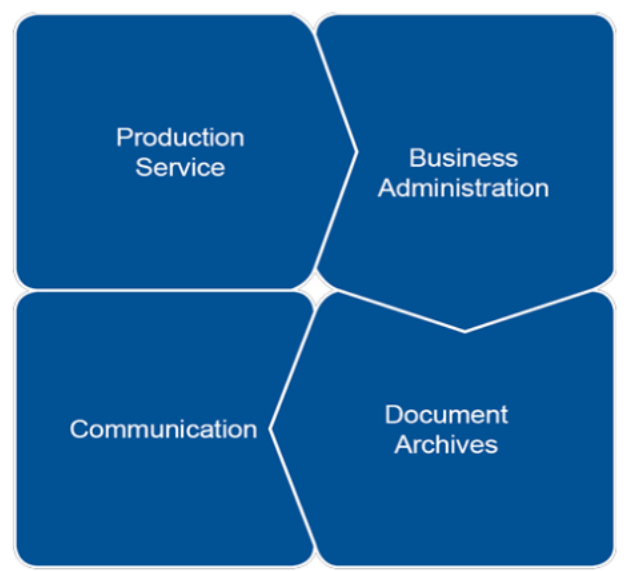
Source: Dewberry Small Business Storm Preparedness Plan, prepared 2013 for SBIDC
PREPARATION
Being prepared means doing the legwork before a disruption occurs. For small businesses this often means focusing on data and systems as well as staff communication. Once you have a recovery strategy, you will test and update it regularly
RESPONSE
During an emergency event small business owners and stakeholders will have to make split second decisions that may affect business continuity.
RECOVERY
While recovery is a long term reality, there are critical decisions and actions that must be prioritized immediately following an emergency event to transition your business back into operating mode
'If Something Happens to Me' PDFFor single-person-operations — and there are many in and around Red Hook — this section is especially important. You hold all the information that keeps your business going. From tangible access points like contact information, account numbers, and passwords. To intangibles like institutional knowledge and relational context.
This worksheet will help you identify gaps and opportunities unique to single-person operators like who has the authority to make decisions? Who has access to your accounts, your systems, your suppliers, your lease?
We have prepared a ‘if something happens to me’ worksheet for you to fill out and share with a trusted person. Fill out the guide and give a copy to the person you trust to act on your behalf in an emergency. Tell them where this document is and make sure they know they’re your designated person. Update it annually. While this document does replace a legal Power of Attorney, it is intended to support the continuity of your business until you’re back on your feet. The worksheet can be downloaded below OR found in Appendix 2 of the full Small Business Preparedness Guide.
R.E.D.E.E. Fest Session 2
Business Continuity 101
Thanks to those that joined Pt. II of our R.E.D.E.E. Fest Series: Business Continuity 101 and BPREP Grant Workshop. If you missed it, feel free to revisit the recording of the full session here, or skim the key takeaways below.
The Big Picture: You’re Not Planning for the Disaster, You’re Planning for the Impacts.
Many small businesses fall into the trap of planning for the last crisis they endured. After a flood, they buy sandbags. After a snowstorm they buy a snowblower. While snowblowers and sandbags are both great resilience items, the concept of business continuity planning focuses more on thinking about the impact an interruption will have on your business rather than the interruption itself.
A few guiding questions that came up in our conversation were:
What is most important to you/your business? What absolutely has to keep running (or be recovered quickly) for your business to survive? These could be things like orders in progress, refrigeration, client list, POS system, inventory, payroll, etc.
Where is your data? Is it only on one physical computer? Is it backed up to the cloud? Would you still have access if you couldn’t get into your space?
We often take power and internet for granted so start by asking:
Which utilities does my business rely on most (electricity, internet, water, gas)?
What happens if I lose one of those for a day, three days, a week?
What basic functions must someone be able to do even if I’m not availablee.g., pay a vendor, contact key customers, access bank accounts, run a simple transaction?
It’s Not Always a Capital-D DISASTER…
Business interruptions aren’t always due to the storm of the century. Sometimes it’s a burst pipe, an unexpected road closure, or a flu outbreak.
Don’t forget about smaller, everyday, or planned disruptions like:
Snowstorms blocking deliveries, staff, or customers for multiple days
Planned water shut‑offs from the Red Hook Coastal Resiliency Project
Heat waves making working conditions unsafe or equipment unreliable
Cyber issues or losing access to your data and systems
For some businesses, a day without water or power is inconvenient; for others (e.g., food manufacturers, cold storage, certain production facilities), it can be catastrophic.
Plan first for the things that are most disruptive for your specific business, not for every possible scenario in the universe.
Keeping Track of It All: Access, Accounts & Passwords
We talked about the sheer volume of accounts, logins, and passwords small businesses have to deal with. In the context of business continuity planning, it’s critical that this information is not only stored securely but that it is shared with the right people.
Some questions that surfaced:
Is there a central place where account information and access instructions live?
Could a trusted person:
Access your bank and pay urgent bills?
Access your social media or website to post an update?
Log into your POS or inventory system to keep things moving?
Business Continuity Planning is Overwhelming. Start Small!
Business continuity planning is overwhelming! Here are a few simple, actionable next steps inspired by the session:
Secure your small business emergency preparedness guide. You can download a pdf OR work on your own copy of the google doc file (Click File → Make a Copy to save your own private version to your Google Drive. Then fill it in, save as you go, and return to it anytime.)
Identify your top 3 vulnerabilitiesFor example: “refrigeration, internet, and access to bank accounts.”
Pick one tiny thing to improve this month
Back up your customer list to the cloud
Write down your key accounts and where the passwords live
Note a temporary location where you or staff could report if your space is inaccessible
Session 2: Business Continuity 101Biz Continuity ResourcesEmergency Planning 101 — a City guide covering the key elements of an emergency action plan and business continuity plan, including employee communications, evacuation procedures, supplier coordination, and a checklist of critical documents to keep on file. (NYC Business)
Business Preparedness Self-Assessment Tool — a free online tool from NYC Small Business Services that helps you understand your business's specific risks and generates tailored recommendations for improving your emergency preparedness. (NYC Business)
Take Action to Prepare Your Business — NYC Emergency Management's five-step business preparedness framework covering hazard assessment, business continuity planning, employee communications, insurance and asset protection, and emergency response. A solid starting point if you don't have a plan yet. (NYCEM)
Ready New York for Business — a free brochure and fillable toolkit from NYCEM with practical, actionable guidance for protecting your employees and keeping your business running before, during, and after an emergency. Available in English and Spanish. (NYCEM)
Tabletop Exercise Toolkit — a free toolkit for running a scenario-based emergency exercise with your team, including an organizer guide, participant guide, and scenario options. A low-lift way to pressure-test your plan before you need it. (NYCEM)
Ready Business — FEMA's business preparedness hub with step-by-step guidance on communications planning, IT recovery, and business continuity planning, including downloadable plan templates and toolkits. A comprehensive resource, though some content may be out of date due to recent gaps in federal funding — verify any specific program availability before relying on it. (FEMA / Ready.gov)
Ready Rating Program — a free American Red Cross program that helps businesses and organizations assess and improve their emergency preparedness. Members get access to self-assessment tools, an Emergency Action Plan template generator, and a resource center with checklists and guides. Free to join; useful whether you're starting from scratch or refining an existing plan. (American Red Cross)
Community Emergency Planning in NYC: A Toolkit for Community Leaders — a comprehensive, NYC-specific planning workbook from NYCEM designed to help community organizations build emergency networks, map resources and vulnerabilities, develop communications strategies, and practice their plans through tabletop scenarios. Includes a full emergency plan template. More thorough than most preparedness guides and specifically built for neighborhood-scale organizations — a strong next step for any business or block association that wants to go deeper than a checklist. (NYC Emergency Management / NYC Citizen Corps)
Partners in Preparedness — a free, nationally recognized NYCEM program that helps businesses and organizations prepare their employees, facilities, and services for emergencies, with access to resources, webinars, events, and real-time alerts through CorpNet. Free to join and open to businesses of all sizes — worth registering so you're plugged into city-level communications when something happens. (NYCEM)
NYC Citizen Corps — NYCEM's community readiness network for nonprofits, CBOs, and faith-based organizations, offering training, preparedness resources, and connections to the City's Emergency Operations Center during a disaster. Registering your organization connects you to the city's preparedness infrastructure and puts you on the list for community-level outreach and resources. (NYCEM)
Adaptation and Resilience Resources for New Yorkers — a New York State directory of state, federal, and community-based resources for businesses, nonprofits, homeowners, and municipalities, filterable by who you are and what you need — whether that's creating a resilience plan, preparing for or recovering from an emergency, or finding funding for resilience projects. A useful aggregator if you want to explore what's available beyond the City level. (Resilient NY)
Adaptation and Resilience Resources — Businesses — the same Resilient NY directory filtered specifically for businesses. Use this version to skip straight to resources relevant to commercial operators. (Resilient NY / NYS)
Business Preparedness and Resiliency Program (BPREP) — a NYC Small Business Services grant that reimburses eligible businesses up to $5,000 for resiliency improvements, including backup generators, flood barriers, and more. RHBA can help you get started — email info@redhookbiz.org. (NYC SBS / RHBA)
Business Continuity: Small Business Planning and Considerations — a step-by-step guide from the U.S. Chamber of Commerce covering how to identify critical business functions, map dependencies, conduct a business impact analysis, develop response procedures, and test and maintain a business continuity plan. More detailed than most guides — useful if you want to go beyond a basic checklist. (CO— / U.S. Chamber of Commerce)
Red Hook Small Business Storm Preparedness Plan — a comprehensive storm preparedness template developed specifically for Red Hook small businesses after Hurricane Sandy by Dewberry Consultants for the Southwest Brooklyn Industrial Development Corporation, covering hazard risk assessment, recovery strategy, communications planning, document archiving, equipment inventory, and a step-by-step storm timeline from 96 hours before landfall through 72 hours after. One of the most Red Hook-specific and actionable planning documents that exists — developed directly from Sandy's impact on this neighborhood. Includes fillable template forms. (SBIDC / Southwest Brooklyn Industrial Development Corporation)
Resources
STAY IN CONTACT
Notify NYC — the City of New York's official, free emergency communications program. To sign up, download thefree mobile application, visit NYC.gov/NotifyNYC, call 311, or follow @NotifyNYC on Twitter. (NYCEM)
Subscribe to the Community Preparedness Newsletter — a weekly NYCEM newsletter with preparedness initiatives, resources, and local events. During emergencies, the newsletter provides important alerts and updates. (NYCEM)
Advance Warning System — provides emergency alerts and information to organizations that serve people with disabilities and others with access and functional needs, managed by NYC Emergency Management in partnership with NYC DOHMH and the Mayor's Office for People with Disabilities. (NYCEM)
Help Now NYC — NYC's resource hub with information about ways individuals and organizations can help those affected by disasters, including guidance on donating and volunteering responsibly after an emergency. (NYC)
GET HELP
RHBA Resources — the Red Hook Business Alliance's resource hub, currently featuring disaster loan guidance and grant opportunities specific to Red Hook businesses. Check back after any emergency event for community-specific recovery tools and updates. (RHBA)
SBA/EIDL Quick Start Guide — an RHBA guide explaining the difference between SBA Physical Disaster Loans and Economic Injury Disaster Loans, what documents you need, and how to apply — written specifically for Red Hook freelancers, independent contractors, and artists who may not know they're eligible. (RHBA)
Resources for Individuals — NYCEM's post-disaster resource hub covering how to report damage, access social services, and navigate recovery programs after a major storm or emergency event. Best used after a disaster, but worth bookmarking and sharing with staff now. (NYCEM)
Contact the Community Preparedness Team — the direct inquiry form for NYC Emergency Management's Community Preparedness program, which helps local organizations build capacity to prepare for, respond to, and recover from emergencies through training, resources, and connections to the City's Emergency Operations Center. Worth reaching out if you want your block or business district connected to city-level preparedness infrastructure. (NYCEM)
Faith Sector Climate Adaptation Toolkit — a flexible, NYC-specific resource for faith leaders of all traditions to learn about severe weather impacts, access government and nonprofit preparedness resources, and equip each other with tools for planning ahead. Relevant beyond the faith sector as a model for how anchor institutions can structure climate communication with their communities. (Rebuild by Design / NYDIS)
Climate Resilience Program — a program launched by New York Disaster & Interfaith Services (NYDIS) for NYC clergy and religious lay leaders serving under-resourced, climate-vulnerable communities, featuring climate resilience resources, networking events, trainings, and vulnerability analyses. A good entry point for connecting Red Hook faith partners to preparedness infrastructure. (NYDIS)
GENERATORS
Generators 101 - an RHBA-compiled use/testing/troubleshooting guide.
Generator Information for Businesses — a NYC Health Department PDF covering FDNY rules for business generators, including permit requirements for fuel storage and CO safety guidelines specific to commercial settings. (NYC DOHMH)
Generator Safety — a New York State guide to safe generator operation covering transfer switch requirements, grounding, GFCI use, and key rules for avoiding carbon monoxide poisoning and electrocution hazards. (NYS Division of Homeland Security and Emergency Services)
Use Generators Safely at Home — a FEMA fact sheet covering the core generator safety rules: never operate indoors or in partially enclosed spaces, always use heavy-duty extension cords, store fuel outside away from appliances, and install battery-powered CO alarms. (FEMA)
Generator Safety Tip Sheet — a free, printable tip sheet from the National Fire Protection Association focused on avoiding carbon monoxide exposure from portable generator exhaust. Good to post on-site or include in your staff safety materials. (NFPA)
Power Generator Troubleshooting: Common Issues and DIY Solutions — a practical guide to diagnosing and resolving the most common generator problems, including starting failures, power output issues, and overheating, with step-by-step DIY fixes. (Northside Power)
Using Portable Generators Safely — an OSHA fact sheet covering the specific hazards of portable generators used during disaster cleanup and recovery, including carbon monoxide poisoning, electrocution, fire, and safe fuel storage practices. Written for worksites and directly applicable to commercial settings. (OSHA)
Portable Generator Troubleshooting Guide — Generac's manufacturer troubleshooting guide for portable generators, walking through common issues by symptom and providing model-specific diagnostic steps. A good first reference if your generator is acting up and you want to work from the source. (Generac)